Understanding How Endocrine Disease Affects Performance Horses
By Glenye Oakford
5 Key Takeaways
Equine endocrine disease affects horses by disrupting hormone balance, leading to metabolic dysfunction, laminitis risk, and whole-body health impacts. Key takeaways include:
- Equine endocrine disease is a whole-horse condition: Most cases are driven by equine metabolic syndrome (EMS) and pituitary pars intermedia dysfunction (PPID, formerly known as Cushing’s disease), affecting metabolism, performance, and long-term health.
- Insulin dysregulation (ID) is one of the main signs of EMS. Elevated insulin is the primary driver of laminitis.
- Dynamic testing is a better way to diagnose endocrine disease. Baseline fasted testing often misses cases; dynamic testing is more sensitive.
- Management of diet and exercise is crucial. Effective care requires coordinated diet, exercise, weight control, and veterinary guidance.
- Nutritional supplementation can provide support. Targeted supplements may help maintain normal insulin function as part of a broader plan.
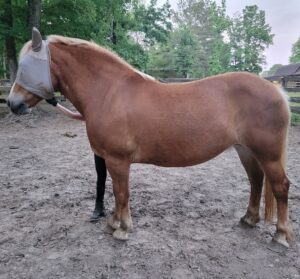
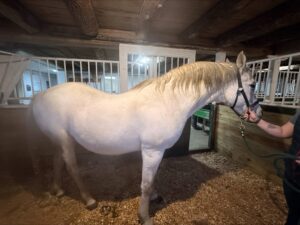
Imagine two horses: One is over-conditioned—a little fat with a cresty neck and fat deposits by his shoulder and tailhead. The other has a very thick coat and some topline atrophy. At first glance, they don’t appear to have anything in common. But they do. Each is suffering from equine endocrine disease. Understanding how endocrine disease affects horses such as these two is essential for managing well-being, performance, and lifespan.
The equine endocrine system includes the glands and hormones that regulate vital functions including blood sugar and insulin, metabolism, hair growth and shedding, temperature, growth, and more. But when endocrine disease disrupts hormone regulation, the consequences can be damaging, even life-threatening.
Endocrine disease is the leading cause of laminitis (founder), which occurs when tissues that connect the coffin bone to the hoof wall (laminae) become inflamed. In severe cases they separate, releasing the coffin bone to rotate downward. But endocrine disease can also have other often underappreciated effects: insulin dysregulation, exercise intolerance, sinusitis, and tendon, bone, and ligament problems, among other issues. Managing those risks starts with supporting normal metabolic function in the whole horse—especially in horses at risk of endocrine disease.
A horses’ reduced ability to lose weight is a sign of a metabolic issue. Credit: Dr. Jane Manfredi
In a 2025 webcast hosted by The Horse, Dr. Jane Manfredi discussed how endocrine disease affects horses, starting with two systemic endocrine disorders in horses: equine metabolic syndrome (EMS), which the first horse described at the beginning of the article has, and pituitary pars intermedia dysfunction (PPID, formerly known as Cushing’s disease), which the second horse has.
“We absolutely should worry about laminitis,” said Dr. Manfredi. “But there’s so much more.”
Recognizing Symptoms of EMS in Horses
EMS affects horses’ hormone regulation, particularly insulin, with broad implications for health and performance. Pony breeds, Arabians, drafts and draft crosses, Tennessee walking horses, Morgans, and Lusitanos are predisposed to EMS. But it can affect others, and identifying symptoms of EMS in horses early can lead to better outcomes. The typical signs of EMS are both external and internal:
- Fat appearance or regional adiposity (regional fat deposits such as a cresty neck or excess fat around the tail head or above the eye) often associated with a body condition score of 7-9.
- Insulin dysregulation. Insulin normally delivers needed glucose to the cells, but high concentrations can be catastrophic for horses. Insulin dysregulation results in a high concentration of the hormone insulin in the blood. Blood tests can help determine whether a horse is insulin dysregulated.
- Laminitis due to insulin dysregulation. Signs of laminitis include “rippled” hooves or a rocked-back posture suggesting front-hoof pain.
Beyond laminitis, though, conditions related to EMS that affect the whole horse include:
- osteochondritis dessicans (OCD), a disease in growing horses where small bone fragments break off because the cartilage didn’t appropriately turn into bone. Studies show that foals born to obese mares with insulin regulation issues are more likely to have OCD.
- reproductive and placental problems. Foals born to mares with insulin regulation issues also had issues with insulin. And obese mares with insulin dysregulation also had more negative changes in their placentas.
- cardiovascular disease, where the health of the heart muscle is affected in insulin dysregulated horses and they also have increased blood pressure.
Diagnosing EMS: Baseline Testing v. Dynamic Testing
Accurate diagnosis plays a key role in understanding how EMS affects horses.
Baseline fasted testing, which involves fasting the horse overnight and then taking a blood test to determine if insulin levels are high, has limits. If 25 of 100 horses have EMS, Dr. Manfredi estimated, baseline fasted tests would likely catch only one.
Dynamic testing with an oral sugar test is more sensitive. Horses receive no grain the night before or on the morning of testing. They then receive a dose of Karo Syrup Light®.
“We take blood samples one hour and an hour-and-a-half later, and we look for insulin,” Dr. Manfredi explained. “In cases where we use this procedure, now we’re finding 20 or 21 of those 25 horses.”
The results can inform diet and exercise strategies for at-risk horses going forward.
Nutritional Strategies for Horses with EMS
Given how endocrine disease affects horses, it’s crucial to work with your veterinarian to carefully manage your horse’s weight, diet, and exercise.
Determine Weight
Start by determining your horse’s weight as accurately as possible so you can determine an appropriate diet and exercise plan. Measuring neck and girth circumference, height, and length, can be useful, Dr. Manfredi said. Apps like Healthy Horse, developed with research by the University of Minnesota and the University of Kentucky, can help translate those measurements in to estimated actual and ideal body weights for several breeds and types of horses.
Reduce NSCs
Next, work to reduce NSCs, or nonstructural carbohydrates (sugars, fructans, and starches). Dr. Manfredi recommends that NSCs make up less than 10% of the diet. “A lot of times, this means eliminating grains or using a lower-protein ration balancer,” she said.
Be aware that hay can sometimes have high sugar, too.
“It’s nice if you’re able to know how much NSCs your hay has, but if you’re not sure and you have a horse at risk, we know that if you can soak that hay in water for at least 30 minutes, we can actually get some of those sugars to leach out of the hay,” Dr. Manfredi said.
Pasture Management Strategies
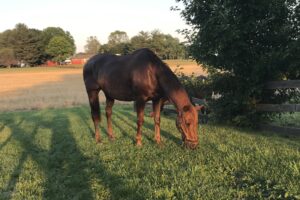
For horses challenged with equine metabolic syndrome, turn out in the early morning when the sugar content in the grass is low.
Time your horse’s turnout carefully, and limit grazing during periods when the grass will have a higher sugar content. Research in Kentucky has shown that NSC load in pasture grass is low overnight. It begins climbing at 8 a.m. and peaks at 7 p.m. For horses with access to grass during turnout, grazing from early morning until 11 a.m. is likely best when grass is growing quickly.
Drought and temperature fluctuations in spring and fall also can alter a pasture’s sugar content.
Be prepared to change the schedule according to season and location, Dr. Manfredi added. For example, a 2025 study found that spring pasture in Kentucky averaged 24% NSCs, she said.
“In springtime, if you have a horse that’s really at risk, you might need to muzzle them or have them on a dry lot,” she said. “We do know that moving them to the dry lot is very effective, because insulin can decrease within just 24 hours.”
Exercise and Other Management Strategies
“Our muscles are number one for the volume of glucose they utilize in our body,” Dr. Manfredi said. It’s the same for horses. Exercise that builds muscle and helps a horse lose weight can help maintain metabolic efficiency. Talk to your vet about an exercise regimen that will benefit your horse.
Dr. Manfredi also suggested avoiding triamcinolone steroid joint injections in horses with insulin dysregulation. These common treatments for arthritis can raise blood insulin levels over the next 72 hours even in normal horses. Dr. Manfredi’s research has shown that these injections in horses with EMS/ID can increase insulin levels enough to trigger a laminitic event.
Nutritional Support for Metabolic Function
Nutritional support can aid a horse’s metabolism, Dr. Manfredi noted. But it’s important to discuss these with your veterinarian.
She does not recommend metformin, a product developed originally for human use that has been used as an equine supplement, because “only 20-30% of horses actually can absorb metformin,” she explained.
Products for hypothyroidism like Thyro-L can increase a horse’s metabolism and contribute to weight loss that helps reduce insulin resistance. But Dr. Manfredi noted that some Standardbred horses have developed arrythmias while on Thryo-L. “If you have a horse that is a jumper, a racehorse, a horse that’s going and doing really high speeds, cross-country, etc., it would make me a little worried to have a horse that might develop an arrhythmia when they’re working that hard,” Dr. Manfredi said.
Dr. Manfredi sees more promise in InsulinWise®, which she tested as part of a study published in 2020. The supplement combines resveratrol and a series of amino acids that work synergistically to support normal insulin levels. “I took some of my most difficult-to-manage Arabians and Morgans from our place here as well as across the country, and for six weeks kept them on the same diet and turnout regimen and fed them this product,” she said. “We did oral sugar tests before we started the product … and compared them to six weeks after feeding the product. What we saw was our insulin concentrations significantly decreased in these horses, and many of them also lost a significant amount of weight, as well.”
PPID and the Aging Performance Horse
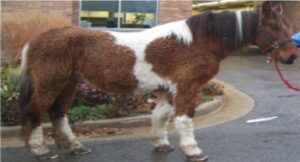
One of the most obvious symptoms of PPID is a heavy coat that doesn’t shed. Credit: Dr. Hal Schott
PPID (Cushing’s) is a common condition in older horses and can influence multiple aspects of performance.
“It’s a benign brain tumor,” Dr. Manfredi explained. “Normally, this part of the brain makes hormones that alter metabolism to prepare for winter.” With PPID, the tumor leads to excessive production of pituitary hormones including include adrenocorticotropin (ACTH).
The most obvious symptoms of PPID include a heavy coat that doesn’t shed, laminitis, excessive sweating or urination, and topline muscle wasting. But some of PPID’s more subtle effects also can have serious ramifications for performance horses.
“We worry about how it affects the suspensory ligament,” Dr. Manfredi said. “It has been associated with proximal suspensory ligament issues as well as suspensory ligament degeneration, or DSLD,” which can reduce the fetlock’s stability.
Muscle-wasting along a horse’s topline also can contribute to back pain, especially during jumping. And horses with PPID have high cortisol levels and are prone to inflammation that can lead to dental disease and sinusitis.
PPID also can reduce bone density. “We do worry about pathologic fractures in these horses,” Dr. Manfredi said.
To test for PPID, Dr. Manfredi recommends conducting a thyrotropin-releasing hormone (TRH) stimulation test between January and June (or a baseline ACTH during the other months). This analyzes the horse’s response to an injected hormone. She follows that with an oral sugar test to really see a horse’s complete endocrine status.
Managing Horses With PPID
It’s important to get your veterinarian’s advice regarding exercise, diet, and medication for your PPID horse. Their recommended protocol might be similar to that for EMS, along with medication.
Until recently, Pergolide (Prascend®) has been the only Food and Drug Administration-approved medication in the U.S. for PPID. A lifelong oral medication typically dosed at a single 1 mg tablet each day, it slows or halts growth in the tumor that causes PPID and prevents abnormal hormone production. (After this webcast was recorded an FDA-approved generic pergolide tablet, Zygolide® was released in 2026.) But muscle-building exercise is still important, Dr. Manfredi stressed.
“We can’t just do Prascend,” she said. “We also have to rebuild some of the muscles that have atrophied.”
Resistance bands can help, as can core-strengthening exercises on the ground.
“The goal is to build up to get your horse to be able to hold [each of these exercises] for about 10 to 20 seconds,” Dr. Manfredi said.
PPID and Insulin Dysregulation
An estimated 30% of horses with PPID also will have insulin dysregulation. Some might show fat deposits similar to those in EMS horses, but thinner patients will need extra calories in a carefully managed diet.
“We can provide calories without exceeding that 10 to 12% dietary nonstructural carbohydrate load by using things like vegetable oil, non-molasses feed pulp, rice bran, and commercial fat supplements, Dr. Manfredi said. “We can also use low-starch feeds and hay cubes if they have bad teeth.”
Insulin dysregulation appears to be a key component of laminitis development in PPID horses.
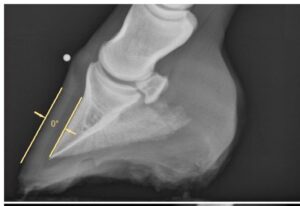
A radiograph of a normal hoof, where the coffin bone is parallel to the hoof wall. Credit: Dr. Jane Manfredi
Laminitis Risk and Supportive Care
Laminitis is perhaps the most feared way that endocrine disease affects horses. “It is the number-one cause of laminitis,” Dr. Manfredi said of equine endocrine disease. “And we know laminitis in these cases is triggered by a high concentration of insulin.”
If insulin dysregulation does progress to laminitis, Dr. Manfredi said, that potentially deadly condition can be difficult to detect early. But it can respond well to rapid treatment, and recent research has identified new therapeutic possibilities.
Continuous icing of the pasterns and hooves, even for as long as three days, can prevent laminitis in horses who are just beginning to founder, Dr. Manfredi said.
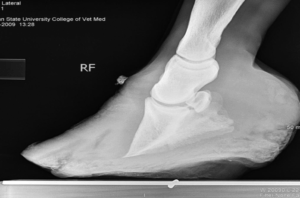
A radiograph of a laminitic hoof, where the coffin bone that has rotated downward. Credit: Dr. Jane Manfredi
Non-steroidal anti-inflammatories—Medications like phenylbutazone can increase horse comfort.
SGLT2 inhibitors—a new class of drugs including canagliflozin, ertugliflozin, and velagliflozin—have shown promise. “They promote the kidney to get rid of glucose, and if you get rid of glucose, you lower blood insulin,” Dr. Manfredi explained. “The good thing is that these are really effective in 24 to 48 hours. The cons are there are some horses that might need this for a really long time if other diet and exercise changes can’t be implemented.” They appear useful for a short term until an acute laminitis threat has passed.
Watch the full webcast with Dr. Manfredi at The Horse.

© Tori Hall Photography
About the Expert
Jane Manfredi, DVM, MS, PhD, DACVS-LA, DACVSMR, is the Mary Anne McPhail Dressage Chair in Equine Sports Medicine and associate professor at Michigan State University’s College of Veterinary Medicine. Her research has included work on the testing, physiology, and treatment of equine metabolic syndrome; the effects of steroid joint injections of insulin-dysregulated horses’ metabolic profiles; and more.
Feature photo credit: Dr. Elaine Norton
Article written by KPP staff.
Copyright (C) 2023 Kentucky Performance Products, LLC. All rights reserved.
The Horse That Matters to You Matters to Us®
Since 1998, Kentucky Performance Products has simplified a horse owner’s search for research-proven nutritional horse supplements that meet the challenges facing modern horses. Our horse supplements target specific nutritional needs and are formulated to complement today’s feeds, thus safeguarding against over-supplementation. Each product is scientifically formulated and made with high-quality ingredients at certified manufacturing facilities. Kentucky Performance Products is proud to offer a quality assurance promise backed by a money-back guarantee. Kentucky Performance Products brings you horse supplements you can count on because the horse that matters to you, matters to us. KPPusa.com