A Guide to Vitamin E and Neuromuscular Disease in Horses
5 Key Takeaways
- Adequate vitamin E is required for neuromuscular health. Horses require green grass for vitamin E. To consume enough vitamin E, horses typically need to graze on green pasture at least 6-12 hours a day for six months out of the year.
- Measure your horse’s vitamin E concentrations annually to determine his baseline vitamin E level. Adequate serum vitamin E levels are between 2 and 6 µg/mL, depending on the lab.
- Vitamin E supplementation should be tailored to the individual horse, not the herd.
- Not all supplements are created equal. Ask companies selling supplements what research has shown about how well their products work.
- Natural vitamin E products raise vitamin E levels more efficiently than synthetic ones.
A handsome gray show hunter arrived at the veterinary clinic with a performance problem that was hard to explain: He was struggling to get clean lead changes, and, more alarmingly, had fallen twice with a junior rider over fences.
This high-level competitor’s blood work revealed that the problem wasn’t due to lameness, poor training, or lack of fitness. His vitamin E level was 1.8 micrograms per milliliter (µg/mL), below the adequate range of 2 to 6. After performing extensive testing for other neuromuscular diseases, which were excluded, the gelding was ultimately diagnosed with equine neuroaxonal dystrophy/degenerative myeloencephalopathy, or eNAD/EDM, a neurological disease tied to low vitamin E.
The gray hunter was one of several cases spotlighted in a 2026 webinar by Carrie Finno, DVM, PhD, Dipl. ACVIM, an equine internist and the Gregory L. Ferraro Endowed Director of the Center for Equine Health (CEH) at UC Davis Weill School of Veterinary Medicine. The webinar was sponsored by Kentucky Performance Products and hosted by The Horse. Her message was sobering: Vitamin E deficiency is more widespread than previously recognized and it can harm a horse’s performance and well-being. Fortunately, protecting horses from neuromuscular disease is possible.
Why Vitamin E Matters
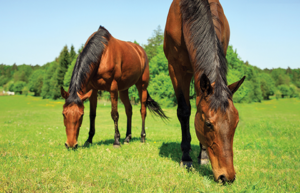
Dr. Finno says horses need to be out on green pasture for at least 6-12 hours a day for six months out of the year to get enough vitamin E stores.
Vitamin E is an antioxidant, the body’s defense against the cell damage that exercise and other stressors can cause in muscles and nerves. When vitamin E levels are too low, muscle fibers and nerves show damage. This results in clinical signs that can include incoordination, weakness, muscle wasting, trembling, and even an unwillingness to back up or to stand still. For equine athletes, the training and performance demands make adequate vitamin E especially important. Others, like horses who are unable to access fresh green pasture, are also at risk.
This nutrient’s role explains the link between vitamin E and neuromuscular disease in horses: When the antioxidant’s protection dries up, muscle fibers and nerves can become damaged.
Low vitamin E levels can show up at first with subtle signs, like a slip in performance, such as a horse that fades as he works, recovers slowly, or has less muscling than you might expect. But the consequences can be serious.
Horses can’t synthesize vitamin E themselves; they evolved to get vitamin E from fresh green grass. Finno said they need to be out for at least 6-12 hours a day for six months out of the year when pasture is green to get enough vitamin E stores. Hay—even high-quality alfalfa—is no substitute, because vitamin E levels begin to drop from the time the hay is mowed.
“If your horses aren’t on pasture and if they’re not getting supplements, they may or may not be deficient, which is why you need to check their levels,” Dr. Finno said. “If they are [deficient], really the only way to increase their levels is either to supplement them or to put them on green pasture.”
How to Measure Vitamin E in Horses
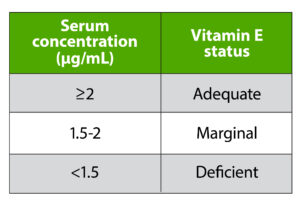
Reference ranges for vitamin E tested via blood plasma
Because vitamin E and neuromuscular disease in horses are closely connected, regularly testing your horse’s vitamin E level is key to catching deficiency early. There are several ways to measure a horse’s vitamin E levels, including testing via blood plasma or serum or muscle.
Dr. Finno provides the following reference ranges for vitamin E in serum:
Adequate: 2 to 6 µg/mL (micrograms/milliliter)
Dr. Finno prefers levels at 3 to 6, which are common levels for horses grazing good pasture.
Marginal: Between 1.5 and 2 µg/mL
Deficient: Below 1.5 µg/mL
Labs report differently, though. Most use micrograms/milliliter, as described above. But Cornell University uses micrograms/deciliter, so its reported numbers run 100 times larger (with “adequate” between 200 and 600). To convert Cornell’s measurements to the more typical micrograms/milliliter, move the decimal point two places to the left. But in 2025, Michigan State University changed the method it uses to measure vitamin E, and there is no way to convert that measurement to other lab results because of the different methodology. That method reports adequate levels between 3 to 9. To avoid discrepancies, Dr. Finno recommends: Pick one lab and stay with it.
Dr. Finno strongly recommends making a vitamin E test part of your horse’s routine annual check, the way a Coggins is. Regularly monitoring your horse’s levels can help you and your veterinarian spot any deficiency early and intervene with a vitamin E supplement before your horse’s performance and health suffer.
Vitamin E deficiency can cause several diseases that vary by age and may also relate to the horse’s underlying genetics. These diseases also clearly reveal the connection between vitamin E and neuromuscular disease in horses. Below are three diseases associated with vitamin E deficiency.
eNAD/EDM: Low Vitamin E in Early Years
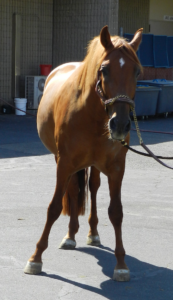
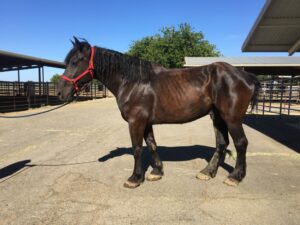
This horse was diagnosed with eNAD/EDM, a neurological disease tied to low vitamin E. Affected horses show symmetric incoordination and stand in an abnormal position without correcting themselves.
Onset: Typically, clinical signs of eNAD/EDM develop between 1-3 years of life. This has been described in many breeds, including Quarter Horse, Warmbloods, Andalusians, Lusitanos and Gypsy Vanners. However, middle-aged Warmbloods and Thoroughbreds can also be affected with eNAD/EDM, as described by research from New Bolton Center at the University of Pennsylvania School of Veterinary Medicine. “Many of the older horses described by Dr. Amy Johnson’s team have had a normal performance career and then present with acute behavioral changes and a more mild incoordination,” Dr. Finno said.
Clinical Signs: Caused by degeneration of neurons in the spinal cord and brainstem, the damage is irreversible. Affected horses show symmetric incoordination and stand in an abnormal position, such as splay-legged, without correcting themselves, because the sensory pathways no longer work. There appears to be a possible genetic factor triggered by inadequate vitamin E in the first years of life. “If you took that same genetically predisposed foal and you raised it in Kentucky on beautiful green grass, that horse would likely not develop eNAD/EDM,” Dr. Finno said.
Diagnosis: A definitive diagnosis can be confirmed only by necropsy. Note: Blood serum results for vitamin E may be sufficient if a horse had previously been supplemented when younger. It is important to rule out cervical compressive myelopathy (i.e. wobbler syndrome) and equine protozoal myeloencephalitis (EPM), which eNAD/EDM can resemble.
Strategy: If needed, irrigate pastures to provide fresh, green grass for broodmares and foals. Supplement mares during pregnancy because the vitamin E passes to their foals through colostrum.
Vitamin E Responsive Myopathy (VEM)
© Amy Young, UC Davis Weill Center for Equine Health | BEFORE: Liberty arrived at UC Davis with chronic weight loss and muscle-wasted hindquarters. He was diagnosed with VEM, a neurological disease caused by vitamin E deficiency.
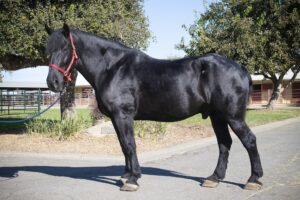
© Amy Young, UC Davis Weill Center for Equine Health | AFTER: Vitamin E supplementation transformed Liberty. He regained weight and muscle and bucked and cantered during turnout.
Onset: Appears in middle-aged horses
Clinical Signs: Hind limb stiffness, trembling, and muscle atrophy, sometimes with weight loss despite a normal, or even ravenous, appetite.
Case study: Liberty, a 16-year-old Percheron, arrived at UC Davis with chronic weight loss and muscled-wasted hindquarters. He was unwilling to back up, taking only a few steps before stopping. “It also showed up when you picked his feet up,” Dr. Finno recalled. “When you tried to pick his feet, he would actually start trembling and have to put that foot right back down.”
Diagnosis: A muscle biopsy from the top of Liberty’s tail, a site sensitive to vitamin E changes, revealed damaged fibers that appeared almost moth-eaten—a sign of vitamin E deficiency. Muscle biopsy, Dr. Finno said, is the definitive diagnostic tool for VEM, because while blood serum might be low in affected horses, it also can be adequate.
Strategy: VEM can be reversed. Vitamin E supplementation transformed Liberty: He regained weight and muscle, began picking his feet up for the farrier, and bucked and cantered during turnout. On Dr. Finno’s advice, Liberty’s owners tested their other horses for vitamin E deficiency and now have a supplementation protocol for their program.
Equine Motor Neuron Disease (EMND): A Disease of Older Horses
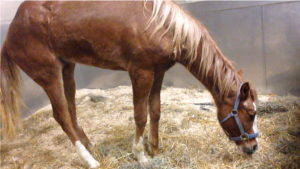
Clinical signs of diagnosed horses with EMND include trembling, discomfort standing still, persistently trying to lie down, continually shifting weight, and standing with all four feet close underneath their bodies.
Onset: Peaks around age 16; appears to require prolonged vitamin E deficiency, which might be why it affects older horses. Younger rescue horses also can develop it after several years of vitamin E deficiency.
Clinical Signs: Acute phase—trembling, uncomfortable standing still, persistently trying to lie down, continually shifting weight, walking, standing with all four feet close underneath their bodies, as if balancing on a small stool. Chronic phase—stiff or profoundly abnormal gait, muscle-wasting and being underweight despite a strong appetite.
Strategy: Horses with EMND have low serum vitamin E levels, Dr. Finno said, but not all deficient horses will go on to develop the disease. Research (Bedford and others, 2013) has suggested that identifying vitamin E deficiency and supplementing the horse early in EMND’s progress can improve a horse’s outcome.
Some Vitamin E-Deficient Horses Appear Normal
Not all horses with low vitamin E levels show noticeable signs of it. Blazer, a Quarter Horse in the UC Davis CEH herd, had vitamin E serum level of 1.5 µg/mL, well below Dr. Finno’s ideal range of 3 to 6 but appeared perfectly healthy, even robust. But a tail-head biopsy told another story: early “moth-eaten” changes in about 4% of his fibers, plus the presence of lipofuscin, a marker of oxidative damage.
“He could be performing adequately at that time but has a kind of a “ticking time bomb” of vitamin E deficiency happening in his muscle,” Dr. Finno said of Blazer.
Dr. Finno has seen this kind of deficiency before, in horses that start strong, then lose energy as they work, becoming less willing to move forward. “And if you look at them, they often have some degree of muscle atrophy,” she said. “They’re not really well muscled, their serum vitamin E will be low. … After you supplement them, you get quite a profound difference in their muscling and also in their willingness to perform again.
“If these horses are deficient, they probably are having some of those changes to the mitochondria in their muscle, which is going to make them not feel great. If we can fix that and make them feel better, you can reverse that and get them back. This is the really powerful thing about learning about vitamin E and how you can intervene sooner rather than later,” she concluded.
That’s why testing for vitamin E annually as part of routine veterinary care is important to managing vitamin E and neuromuscular disease in horses: It will allow you to identify any deficiency early so you can intervene with an appropriate vitamin E supplement. It also will help tell whether the supplement is working.
How Should You Supplement Vitamin E?
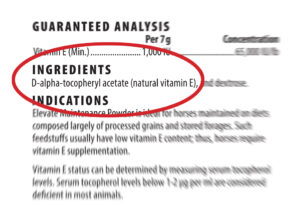
Natural powder or pellets list d-alpha-tocopheryl acetate, and natural liquid lists d-alpha-tocopherol.
Both natural and synthetic vitamin E products are on the market, and knowing the difference is important. Product ingredients that include dl-alpha tocopheryl acetate are synthetic; the “dl” in the compound is the giveaway. Natural powder or pellets list d-alpha-tocopheryl acetate, and natural liquid lists d-alpha-tocopherol.
Regarding which to give, if you supplement with synthetic, you must give a lot, and it takes a long time to raise levels. “I don’t think it’s worth your money,” Dr. Finno said.
Whether your horse needs powder/pellet or liquid depends on how fast you need to raise his vitamin E level. Natural powder or pellet is convenient to add to feed but takes eight to 10 weeks to raise levels. That’s fine in a horse who has no clinical signs of disease.
By contrast, water-soluble natural vitamin E liquid can double blood levels in two to three days, which is better for horses with clinical signs or under acute stress. “If you have a horse with neuromuscular disease, I’m going to tell you to reach for that natural liquid formulation, because I don’t want to wait a few months to get their levels up,” Dr. Finno said.
Finally, treat the individual horse, not the herd. Horses can respond differently even if they’re all taking the same supplement at the same dose. When Dr. Finno reduced the Percheron Liberty’s dose after his serum levels drifted high, his clinical signs returned within a week. “You have to tailor the number to the horse,” she said.
The only way to be certain that the supplement and dosage are working, Dr. Finno said, is to monitor each horse’s vitamin E levels through periodic retesting. For large operations where that might be cost-prohibitive, she recommends prioritizing broodmares in the final trimester, especially when their foals will lack good pasture.
Can You Give Too Much?
Vitamin E was long considered very safe in horses, because traditional supplements could not push levels high enough to cause trouble. But highly bioavailable liquids have changed that. Over-supplementation may interfere with beta-carotene absorption. “And the Nutritional Research Council has said that if you give [humans] too much vitamin E, it can lead to bleeding disorders, or coagulopathy—a problem with bleeding or clotting—because it interferes with vitamin K,” Dr. Finno said. Her team is studying whether this concern applies to horses at relevant doses, with Kentucky Performance Products aiding in the research. This ongoing research is supported by the American Association of Equine Practitioners’ Foundation for the Horse through the Chromatic Fund.
Until those results are in, one thing remains certain: Regularly testing your horse’s vitamin E levels can help prevent over-supplementation and ensure he stays in the “adequate” range.
The webcast that is the basis for this article was sponsored by Kentucky Performance Products. Watch the full presentation at TheHorse.com.
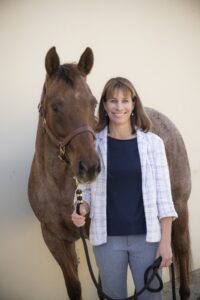 About the Expert
Carrie J. Finno, DVM, PhD, Dipl. ACVIM, is a veterinary clinician scientist at the University of California, Davis, with a PhD in comparative pathology and post-doctorate training in comparative genomics. Finno has published over 150 papers. In the field of veterinary medicine, she has defined the clinical phenotypes and identified the associated genetic mutations for five newly described diseases in horses. The focus of her translational research is the interplay of vitamin E and neurodegeneration using animal models.
Article written by KPP staff.
Copyright (C) 2023 Kentucky Performance Products, LLC. All rights reserved.
The Horse That Matters to You Matters to Us®
Since 1998, Kentucky Performance Products has simplified a horse owner’s search for research-proven nutritional horse supplements that meet the challenges facing modern horses. Our horse supplements target specific nutritional needs and are formulated to complement today’s feeds, thus safeguarding against over-supplementation. Each product is scientifically formulated and made with high-quality ingredients at certified manufacturing facilities. Kentucky Performance Products is proud to offer a quality assurance promise backed by a money-back guarantee. Kentucky Performance Products brings you horse supplements you can count on because the horse that matters to you, matters to us. KPPusa.com