
Spring Turnout Tips for Sugar-Sensitive Horses
Click here to download a print version of this infographic.
Text-only version of “Spring Turnout Tips for Sugar-Sensitive Horses”
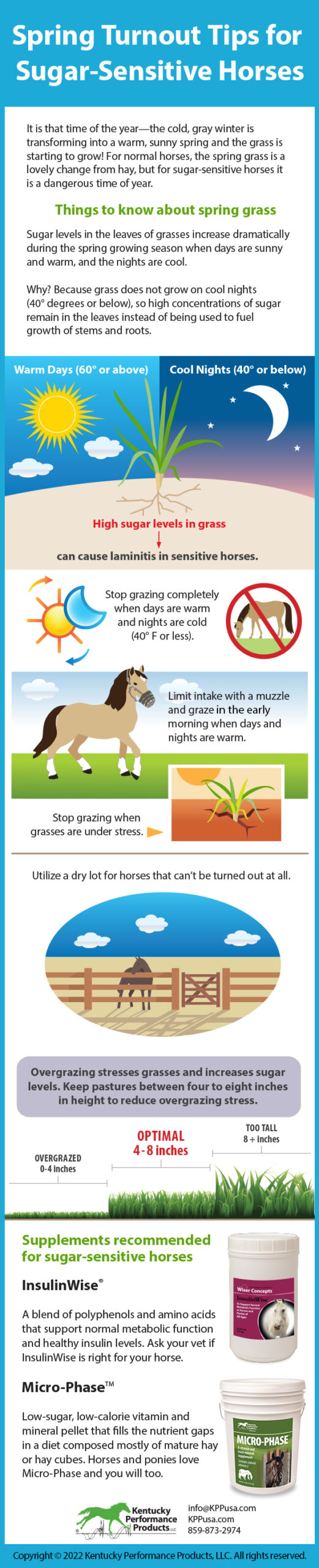
It is that time of the year—the cold, gray winter is transforming into a warm, sunny spring and the grass is starting to grow! For normal horses, the spring grass is a lovely change from hay, but for sugar-sensitive horses it is a dangerous time of year.
Things to know about spring grass
Sugar levels in the leaves of grasses increase dramatically during the spring growing season when days are sunny and warm, and the nights are cool.
Why? Because grass does not grow on cool nights (40° degrees or below), so high concentrations of sugar remain in the leaves instead of being used to fuel growth of stems and roots.
Warm Days (60° or above) + Cool Nights (40° or below) = High sugar levels in grass that can cause laminitis in sensitive horses.
Grazing Strategies
- Stop grazing completely when days are warm and nights are cold (40° F or less).
- Limit intake with a muzzle and graze early in the morning when days and nights are warm.
- Stop grazing when grasses are under stress.
- Utilize a dry lot for horses that can’t be turned out at all.
- Overgrazing stresses grasses and increases sugar levels. Keep pastures between four to eight inches in height to reduce overgrazing stress.
- Overgrazed 0-4 inches
- Optimal 4-8 inches
- Too tall 8+ inches
Supplements recommended for sugar-sensitive horses
A blend of polyphenols and amino acids that support normal metabolic function and healthy insulin levels. Ask your vet if InsulinWise is right for your horse.
Low-sugar, low-calorie vitamin and mineral pellet that fills the nutrient gaps in a diet composed mostly of mature hay or hay cubes. Horses and ponies love Micro-Phase and you will too.
Article written by KPP staff.
Copyright (C) 2023 Kentucky Performance Products, LLC. All rights reserved.

The Horse That Matters to You Matters to Us®
Since 1998, Kentucky Performance Products has simplified a horse owner’s search for research-proven nutritional horse supplements that meet the challenges facing modern horses. Our horse supplements target specific nutritional needs and are formulated to complement today’s feeds, thus safeguarding against over-supplementation. Each product is scientifically formulated and made with high-quality ingredients at certified manufacturing facilities. Kentucky Performance Products is proud to offer a quality assurance promise backed by a money-back guarantee. Kentucky Performance Products brings you horse supplements you can count on because the horse that matters to you, matters to us. KPPusa.com
4 Comments
My pony is 25 and a long time sufferer of laminitis. She is low weight now which only gets worse with locking her up. How do I put weight on her without causing another bout of laminitis?
Hi Meg –
Thank you for your question. Here are some suggestions:
• At all costs, avoid feeding straight cereal grain, such as oats, and corn and sweet feeds containing these grains along with molasses. All these tend to be very high in NSC (nonstructural carbohydrates).
• The first option for increasing your pony’s calorie content is to increase the amount of hay being fed. A low NSC (10-12%) good-quality grass hay is an appropriate option. The hay can be soaked to further reduce the NSC level.
• Next, look at adding low-NSC, dense calorie sources, such as fats and fermentable fiber. Many feed companies offer these types of feeds, formulated primarily from beet pulp and rice hulls (fermentable fiber sources) and fats (vegetable fat, rice bran, flaxseed). These feeds tend to have a much lower NSC level (15 -25%) compared to grain-based feeds that can be as high as 50% NSC. Additional fat can be added to the diet with fat supplements, such as EndurExtra or WeightGainWise (both of these are 50% fat) or Equi-Jewel (18% fat). All these options are low in NSC.
• If you don’t want to feed a commercial feed, you can feed beet pulp and fat sources but need you’ll need to add a balancer/vitamin and mineral source such as Micro-Phase.
• Fat sources high in Omega 3s can be especially beneficial as they add calories but also add an anti-inflammatory benefit.
Good luck with your pony. Take care.
Hello my horse (15yrs) foundered over the winter due to eating too much 3rd crop alfalfa. She was lame on one hoof although both were affected. I had the IRAP therapy done on her which helped the lameness. If I feed the insulin wise to her daily am I able to let her graze occasionally? Or must I still watch her diet?
Our research team recommends that horses who have foundered due to insulin dysregulation should remain on a low sugar diet even when supplemented with InsulinWise. Nutritionists have established that a diet containing no more than 10% sugar is the safest for horses with metabolic syndrome.